


Skip to content

Conditions

Spondylolisthesis (Slipped Vertebra) Care in Cheras, Kuala Lumpur

Spondylolisthesis means one vertebra has shifted forward on the one below it, most often low in the back. It is a bone that has moved, not a disc, which is why the everyday name is a slipped vertebra rather than a slipped disc. The two common kinds look quite different. Degenerative spondylolisthesis comes from wear in the disc and joints and usually shows up after 50. Isthmic spondylolisthesis starts with a small stress crack in the back of the vertebra, called spondylolysis, often from sport in the teenage years. Many slips are small and stable, and plenty are found by chance on an X-ray taken for something else. Low grade slips are usually managed without surgery. The assessment works out whether the slip is actually the source of your pain and whether it is stable.

5.0230 Google reviews

Open seven days · Cheras, Maluri

Registered chiropractors and physiotherapists in Cheras, Maluri. Open seven days, right beside Sunway Velocity.

  • Association of Chiropractic Malaysia
  • Gonstead Chiropractic Society Australia
  • ACCP accredited
  • Best Services 2023 award

Key takeaways

The short answers

What is spondylolisthesis?
One vertebra shifted forward on the one below, most often in the lower back. It is a bone that has moved, not a disc that has bulged.
Does a slip on my X-ray explain my back pain?
Not always. Slips and stress cracks are found in many adults who have no back pain, so the examination decides whether the slip is the source of yours.
Which kind is most common?
In adults over 50, degenerative spondylolisthesis from wear in the disc and joints. In active teenagers, the isthmic kind that starts with a stress crack.
When is surgery considered?
Usually for a high grade slip, nerve symptoms that keep getting worse, or pain that has not settled with a good period of conservative care.
When are you open?
Seven days a week, at Sunway Velocity in Maluri. Monday to Thursday and Saturday until 8pm, Friday until 5pm, Sunday until 3pm.

Does this sound like you?

Common signs

  • A low back ache that is worse when standing or arching backward and easier when sitting or bending forward
  • Hamstrings that feel unusually tight
  • Pain, tingling or heaviness into the buttocks or legs when walking
  • Back pain in a teenager that gets worse with sport, such as gymnastics, badminton, fast bowling or weightlifting
  • A feeling that the lower back gives way or catches
  • Stiffness after standing for a long time

This list describes the condition in general. It is not a diagnosis. Only an in-person assessment can tell you what is causing your symptoms.

What contributes to it

Why it happens

Wear in the disc and joints (degenerative spondylolisthesis)
As a disc loses height and the facet joints behind it wear, the segment can loosen enough for one vertebra to drift forward a little. This is the most common kind in adults, more common in women, and usually at the second lowest level of the lower back.
Illustration of a man in his sixties standing in side profile with one hand on his lower back, where a golden glow sits
A stress crack from repeated arching (isthmic spondylolisthesis)
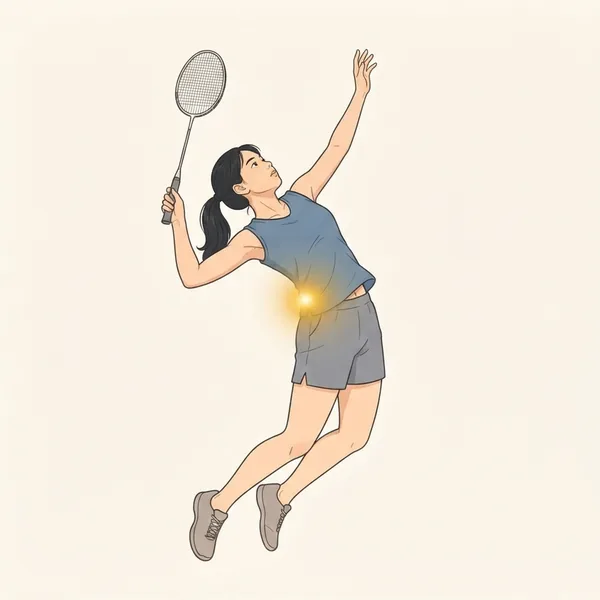
Sports that bend the lower back backward again and again load a thin bridge of bone at the back of the vertebra. Over time it can crack, which is spondylolysis, and if the crack separates the vertebra can slip forward. It usually affects the lowest level of the lower back.
Illustration of a teenage badminton player arching back to smash a shuttle, with a golden glow at her lower back
Growth spurts in teenagers
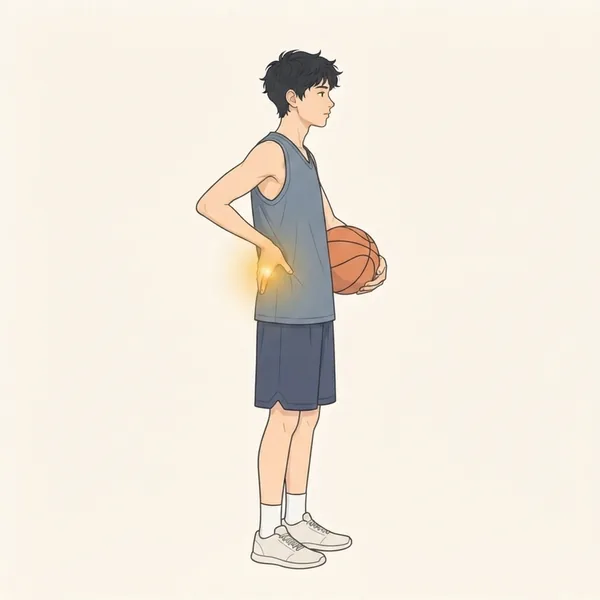
A slip linked to a stress crack is most likely to progress during a period of rapid growth, which is why back pain in an active teenager is taken seriously rather than put down to growing pains.
Illustration of a tall teenage boy holding a basketball under one arm and pressing his other hand to his lower back, where a golden glow sits
Injury or the shape of the spine from birth
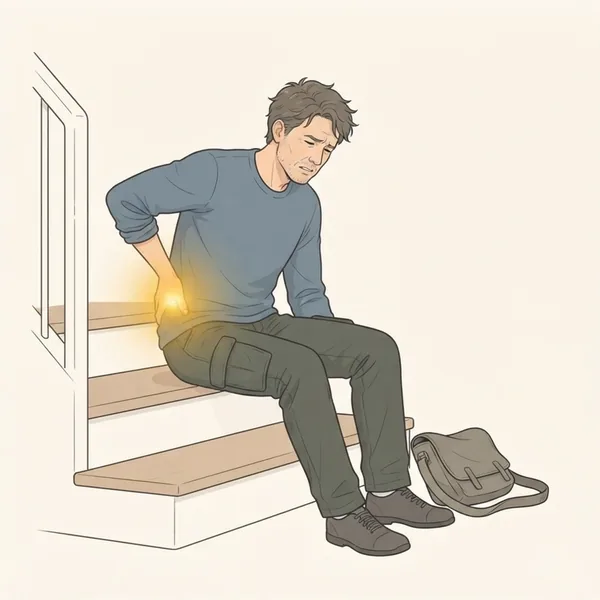
Less often, a slip follows a significant injury, or the vertebrae have been shaped in a way that allows it since birth. These are uncommon, and they are part of what imaging is used to rule in or out.
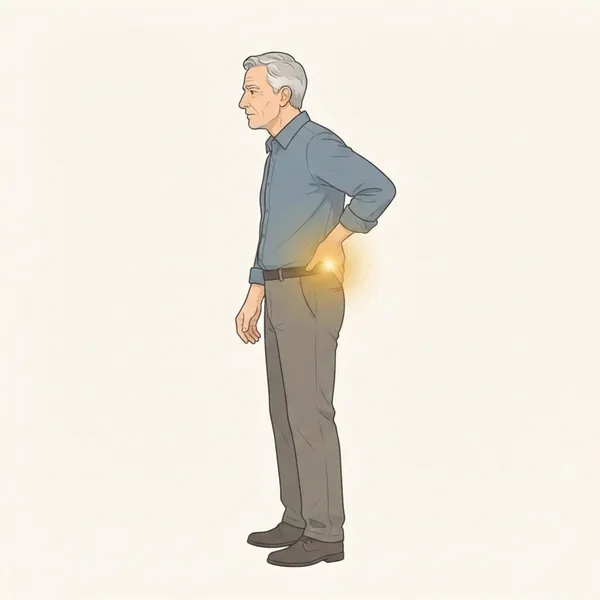
Illustration of a man sitting on the bottom step of a staircase after a fall, one hand on his lower back, where a golden glow sits

How we help

Our approach

  1. Finding out whether the slip is the source, and whether it is stable

    Your first visit follows the Gonstead six-step assessment: history, visualisation, instrumentation with the nervoscope, palpation, and X-ray analysis where indicated, with a neurological examination of the legs added on this presentation. Where further imaging is needed, or a scan you already have needs to be read alongside the examination, we arrange or review it. A high grade slip, signs that the segment is unstable, or nerve signs that are getting worse mean a referral to an orthopaedic or spine specialist.

  2. What an adjustment does and does not do with spondylolisthesis

    The assessment decides whether any adjustment is appropriate. The slipped level itself is not forced back into place, and an adjustment does not reposition a vertebra that has moved forward. Where the assessment supports it, neighbouring levels that have become restricted may be adjusted by hand, and some presentations are not adjusted at all.

  3. Trunk strength and how you load the slipped level

    Our physiotherapy side leads the longer part of the work: deep trunk and hip strength, hamstring flexibility, and changing habits that keep the lower back arched for long periods, such as standing with the hips pushed forward. For athletes, the return to sport is graded rather than all at once.

  4. A teenager with a suspected stress crack

    If spondylolysis is suspected in a young athlete, imaging and a medical opinion come first, along with a break from the sport that provokes it. A brace is sometimes used early on to let a recent crack settle. We coordinate with the doctor and help with the return to sport afterwards, rather than adjusting through a fresh stress fracture.

When to seek urgent care

See a doctor first if you have any of these

These need a medical assessment before you begin chiropractic care. If any apply to you, contact a doctor or go to the nearest emergency department.

  • Loss of bladder or bowel control, or numbness around the groin, buttocks and inner thighs
  • Weakness in a leg that is getting worse, or a foot that drags when you walk
  • Leg symptoms in both legs that are getting worse
  • A teenager with back pain from sport that has lasted more than two to three weeks, or that wakes them at night
  • A child or teenager whose walk or posture has changed, with very tight hamstrings
  • Back pain after a significant fall, road accident or direct blow
  • Fever, unexplained weight loss, or a history of cancer alongside new back pain

Frequently asked questions

What patients ask us

Can a chiropractor fix spondylolisthesis?

No, and we would rather be plain about that. An adjustment does not move a slipped vertebra back into place, and nobody should promise you that it does. What care aims at is the pain, the stiffness around the slipped level and the strength of the muscles that support it. Many people with a low grade slip manage well this way, and the assessment tells us whether you are likely to be one of them.

Is it safe to have a chiropractic adjustment with spondylolisthesis?

It depends on the grade of the slip and whether the segment is stable, which is why the assessment comes before anything else. The slipped level itself is not forced back into place. Neighbouring levels that have become restricted may be adjusted where the assessment supports it, some presentations are not adjusted at all, and high grade or unstable slips are referred to a specialist. Tell us about any leg weakness, numbness or bladder changes when you book.

What do the grades of spondylolisthesis mean?

The grade describes how far the vertebra has slipped forward, as a share of the width of the bone below. Grade 1 is under 25%, grade 2 is 25 to 50%, and grades 3 and 4 are over 50%. Low grade slips, grades 1 and 2, are by far the most common and are usually managed without surgery. High grade slips are more likely to press on nerves and to need a surgical opinion.

Will my spondylolisthesis get worse over time?

Most slips change little. In a long term study of degenerative spondylolisthesis, about a third of slips progressed, and whether a slip progressed had no clear link to how much it hurt. The body also tends to stiffen a loose segment with age, which can steady it. New or worsening leg symptoms are the thing to watch, more than the measurement on a report.

Is a slipped vertebra the same as a slipped disc?

No. In spondylolisthesis a whole vertebra has shifted forward. A slipped disc is the soft disc between two vertebrae bulging or herniating, while the bones stay where they are. They feel different too: a disc problem tends to hurt with sitting and bending forward, while a slipped vertebra tends to hurt with standing and arching back. Our page on a slipped disc covers the disc side in full.

My teenager has back pain from sport. Could it be spondylolysis?

It could be. Spondylolysis is one of the more common causes of persistent low back pain in active teenagers, especially in sports that arch the back repeatedly. Pain that lasts more than a couple of weeks, gets worse with arching, or comes with tight hamstrings is worth having imaged by a doctor first. Once a stress fracture has been ruled out or has settled, we can help with strength and the return to sport.

What exercises are safe with spondylolisthesis?

Exercises that build the deep trunk and hip muscles without arching the lower back are the usual starting point, along with gentle hamstring stretches. Repeated back bends and heavy overhead lifting tend to load the slipped level, so leave those out until you have been assessed. Our post on lower back pain exercises has a strength stage that suits many people with a stable slip, but skip any exercise in it that arches your back.

Can spondylolisthesis cause spinal stenosis?

Yes. When a vertebra shifts forward, it narrows the canal at that level, and the two often turn up together in people over 50. The leg pattern then matches spinal stenosis, with heavy or tingling legs on walking that ease with sitting or leaning forward.

Telling them apart

Spondylolisthesis, spondylolysis, slipped disc or spinal stenosis?

These four get confused because the names sound alike and they can turn up together. This is a rough guide to how they differ, and the linked columns go to the page that covers each in full.

What is being comparedSpondylolisthesisSpondylolysisSlipped discSpinal stenosis
What has happenedA vertebra has shifted forward on the one belowA stress crack in the back of a vertebra, with no shift yetDisc material bulging or herniating between two vertebraeThe canal the nerves run through has narrowed
Who it usually affectsAdults over 50, or teenagers and young adults who play sportActive teenagers, especially in sports that arch the backMost often adults between 30 and 50Mostly people over 50
What tends to aggravate itStanding for long and arching backwardArching backward and twisting in sportSitting, bending forward, coughing or sneezingStanding and walking
Usual first stepAssessment, with imaging reviewed or arranged where neededA doctor and imaging first in a young athleteAssessment, with imaging only if it would change the planAssessment, including a check for a circulation problem

They overlap. A slipped vertebra can narrow the canal, and a stress crack is often how an isthmic slip begins. Imaging read alongside the examination is what tells them apart.

Is this right for you?

Not sure if we can help with spondylolisthesis (slipped vertebra)?

Tick anything that sounds like you. We will read it back honestly and tell you where to start, even if that is somewhere else.

Select the concerns that apply to you
Ask us on WhatsApp

Opens WhatsApp with your answers filled in. Nothing is sent until you press send there.

From our patients in Cheras

What people say after being seen here

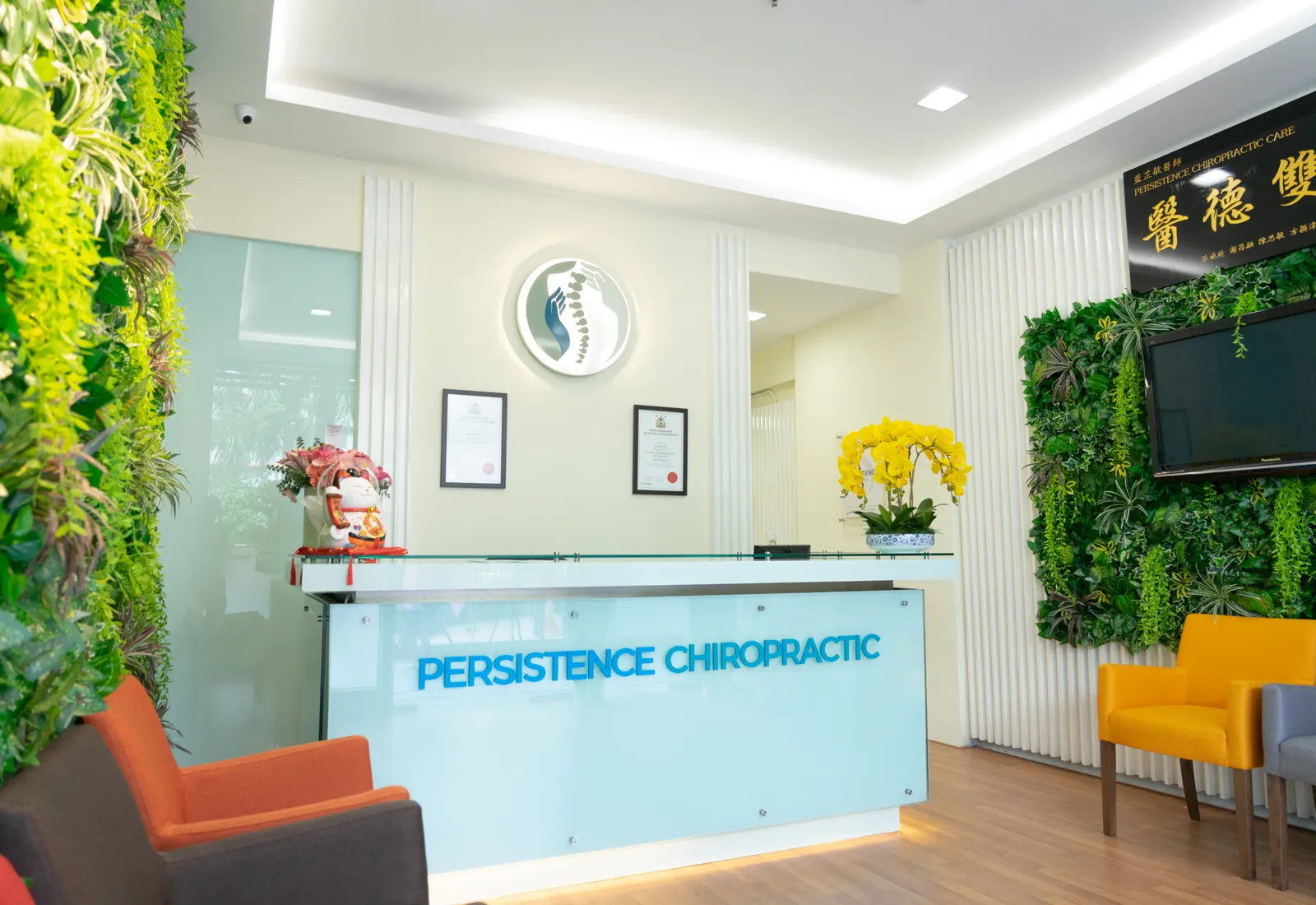
Reception at Persistence Chiropractic Care, Sunway Velocity, Cheras Kuala Lumpur

Persistence Chiropractic Care

230 Google reviews

Write a review
  • Hishamuddin Badaruddin6 months ago

    As a medical doctor, I myself, like my fellow doctors, am usually my very own worst patient. I came to see DC Valerie with a back pain which I should have sorted out weeks ago. I was in KL for a short day trip and decided to get treatment as I had the afternoon free. I initially contacted another chiropractic clinic who did not have any slots open but recommended Dr Valerie. Well Dr Valerie is knowledgeable - diagnosed my scoliosis and that my right shoulder pain was due to my mid-thoracic region and that my back pain was due to other issues. Highly recommended and worth it! Need several sessions and self awareness for posture and flexibility - and back strengthening.
    Read more
  • Shamil Ataev4 months ago

    I cannot recommend Dr. Rynn enough! He's incredibly smart, warm, and welcoming, which instantly put me at ease. What really set Dr. Rynn apart was how amazing he was at explaining everything. He broke down exactly what was going on with my spine and walked me through the entire treatment plan so I never felt left in the dark. The best part? I was able to get my consultation and treatment done all on the same day. The adjustment itself was fantastic, and I felt instant relief in my lower back the moment it was done. It’s rare to find a practitioner who combines top-tier expertise with such a great bedside manner. If you are looking for a skilled, compassionate, and efficient chiropractor, do yourself a favor and see Dr. Rynn. I would highly recommend him to anyone and everyone!
    Read more
  • A C3 months ago

    We brought our daughter here for chiropractic adjustments, and we’ve seen encouraging progress. She has become more responsive, and it has honestly changed the way we think about pediatric chiropractic care. We’re so glad we followed their recommendation to see Dr. Valerie, who specializes in pediatric chiropractic. Thank you for your care and dedication!
    Read more
  • Yit Yew Fei3 months ago

    正规的chiropractic clinic不多,Persistence算一个。5 stars给Kee Shan,手法利落不啰嗦,几次调整下来肩颈松了很多。值得信赖的专业度。
    Read more
  • Kah Mun Wong3 months ago

    My back felt much better after receiving treatment from Dr Valerie. She is also very helpful in giving advice on workouts or ways to take care of my back. Highly recommended!
    Read more
  • Wong Xi Rong3 months ago

    Have been doing chiro session with Dr Valerie since 2022. She is very professional, trustable and understanding.
    Read more
  • Zu En Chiang4 months ago

    I have a great experience with Valerie, she is patient and professional. She took the time to explain my condition clearly, listened to my concerns, and made sure I felt comfortable before starting any treatment.
    Read more

References

  1. On CT of an unselected adult community sample, spondylolysis was found in 11.5% of people, and no significant association was found between spondylolysis or spondylolisthesis and low back pain. Kalichman et al. (2009), Spine, Framingham Study
  2. In a study of degenerative spondylolisthesis, slippage progressed in 30% of patients, and progression did not correlate with symptoms. Matsunaga et al. (1990), Spine
  3. Spondylolysis and spondylolisthesis are common causes of low back pain in children and adolescents, particularly in sports that stress the lower back, and most low grade cases improve with nonsurgical care. High grade slips, over 50%, are more likely to need surgery. OrthoInfo, American Academy of Orthopaedic Surgeons
  4. Spondylolisthesis is most common in the lower back, is often worse when standing or walking and eased by sitting or bending forward, and physiotherapy is among the usual first approaches. NHS, Spondylolisthesis

Ready to stop working around the pain?

Message our Gonstead chiropractors today. Open seven days, right next to Sunway Velocity.